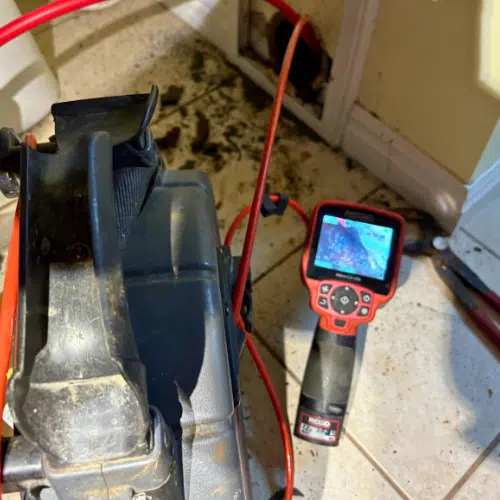
Being told to dig up a sewer that still works? Or paying to clear the same blockage again? The part worth sorting out is what has actually failed—and whether the proposed repair fixes it.
Old pipe alone would not be enough reason for me to replace a whole sewer. I’d want to see what has failed and the pipe on either side of it. One bad joint may call for a local repair; damage along the run can make a bigger job sensible. Repeated backups matter, too. A line that drains today can still have trouble that cleaning won’t fix. But “it’s old” hasn’t answered any of that.
Ask before you sign
Can you show me what is wrong, where it is, and why the rest of the line needs replacing?
You don’t replace a sewer just because the inside looks rough. You do need to know whether there’s a break, a joint that has shifted, or another defect that could cause trouble. No backups is useful information, but it doesn’t make a defect harmless. I’d get someone to review the full recording and explain the reason for doing it now. A blurry clip and the age of the house wouldn’t settle it for me.
How deep is it, and what is over it? A short repair under a driveway can involve more work than a longer one in an open yard. The pipe has to be reached, repaired and covered again, then the surface put back. That doesn’t make any price reasonable. It tells you what to compare. If one quote stops at filling the hole and another includes the concrete, the difference is buying something real.
Can I have it cleaned and put the repair off?
Sometimes, provided the pipe can still be cleaned safely. But a jetter won’t lift a sagging section back into place. If sludge is collecting in that low spot, cleaning may get it flowing without fixing why it collects there. Find out whether the plumber is offering maintenance or a repair. Then weigh the repeat visits and chance of another backup against fixing the pipe. Nobody can promise you a trouble-free year from a camera picture.
An offset means two sections no longer meet evenly. How far they have moved matters more than how ugly a close-up looks.
A small irregularity and a badly displaced joint do not justify the same work. Get the person recommending repair to explain the difference in your recording.
Is one section bad, or does the rest of the pipe need replacing too?
REPAIR
When repair is worth pricing
A local repair is worth considering when the trouble is confined to one section and the remaining pipe can stay. The important part is knowing what remains. Fixing the first bad joint you can see may leave a second problem farther along.
REPLACEMENT
When replacement makes sense
Widespread damage can make repeated small repairs poor value. So can a run whose slope needs correcting. The bigger job should solve a problem the smaller repair would leave behind, and the contractor should be able to show you that problem.
A QUOTE IN FRONT OF YOU?
What are you being told?
Pick your question. Read the short answer. Copy what to say to the plumber.
THE WORKThey found roots. Do I need a whole new sewer line?+
Roots alone do not explain why every foot of pipe must be replaced. Ask to see the video and have them point out the damaged spots. Then ask why cleaning or a smaller repair would not solve the problem.
Ask to see
A copy of the camera video.
Where the damage is and how much pipe was checked.
Why that much pipe needs replacing.
YOU CAN SAY
Show me the damaged spots in the video. Why replace the whole line instead of cleaning it or fixing a smaller section?
Read the detail
The finding needs a location and an explanation. NASSCO separates obstructions and maintenance issues from structural defects when assessing a sewer. Ask which section is damaged, how much of the line was inspected and why the proposed length needs replacement.
THE WORKWill high-pressure cleaning fix my sewer pipe for good?+
It can clear buildup and help water flow again. It does not rebuild broken pipe. Ask what the camera shows after cleaning and whether any damage still needs a repair.
Ask to see
What was blocking the pipe.
The camera check after cleaning.
Any damage left behind.
YOU CAN SAY
After cleaning, is the pipe sound? Show me anything that still needs fixing.
Read the detail
Jetting cleans a line. EPA’s wastewater rehabilitation guide discusses it as a way to remove deposits and obstructions; structural repair is a separate decision. Ask what condition the pipe is in and what the inspection after cleaning shows.
THE WORKDo they really have to dig up the whole line?+
Sometimes. Ask why a smaller repair or a method that needs less digging will not work. The answer should be about your pipe: where it is broken, how it slopes, and how the crew can reach it.
Ask to see
The damaged section and its location.
Other repair choices they considered.
What must be dug up and put back.
YOU CAN SAY
Could you fix a smaller section or use a method with less digging? If not, show me why.
Read the detail
Ask which alternatives were evaluated. EPA documents spot repairs and several rehabilitation methods as well as replacement. Whether one fits a residential lateral depends on its condition, access and the work needed; a list of methods is not proof that lining will work at your house.
THE WORKDoes this price include putting my house or yard back?+
Get that in writing. Fixing the pipe may not include closing the wall, replacing concrete or repairing the lawn. Ask what you will be left with and who pays if the crew finds more work.
Ask to see
Pipe work, cleanup and repairs to walls or the yard.
Anything the price does not include.
How you approve extra work and its price.
YOU CAN SAY
When you leave, what will be fixed and put back? What costs extra, and will you ask me before adding work?
Read the detail
Put the finish line in writing: repaired pipe, closed walls, restored concrete, or all of those? Utah DOPL’s sample construction agreement provides a written process for changes in work, cost and time. It is a useful comparison for a proposal, not a statement that every contract uses that form.
Start with the lowest-priced option that fixes the problem properly. Then ask what the next level adds. A fancy name does not tell you whether you are buying better equipment, more work or a longer warranty.
Ask to see
All package prices on one page.
The repair included in each.
Extra parts, work and warranty coverage.
YOU CAN SAY
Show me all the prices. Which option fixes my problem properly, and what does the extra money buy?
Read the detail
A package name tells you little about the work. Get the cash total and scope for every option, then identify which one corrects the diagnosed fault. Compare the extra equipment, warranty and service promises separately.
Why we ask this
ServiceTitan’s public playbook describes commissioned technicians at a seven-franchise Roto-Rooter group and training that withholds prices during the explanation. It also describes the intended benefits of clearer options. This is a specific example, not a policy established for every plumber or franchise.
THE PRICEIt took 30 minutes. Why does it cost that much?+
Check whether you agreed to a price for the whole repair or to pay by the hour. A repair price may cover travel, parts and business costs too. A quick job does not mean that money is the plumber’s hourly pay. For hourly work, check the time charged.
Ask to see
The price you agreed to.
What the repair includes.
The hours and hourly rate, if that is how you are paying.
YOU CAN SAY
Am I paying for the whole repair or by the hour? What is included, and what could cost extra?
Read the detail
First check what you agreed to buy. A fixed task price is not a timesheet: the company may build it from estimated labor, materials, overhead and profit. Finishing quickly does not tell you what the technician earns or make the bill automatically wrong. If the agreement was hourly, the rate, billing increments and time charged are the relevant comparison.
Questions are editorial examples, not quotations attributed to a particular company. Sources checked September 12, 2026. Each answer links to its supporting sources. A documented sales method does not establish what happened on your visit.
FROM MTNMANPLUMBING.COM
Recent Mountain Man work.
Published job stories matched to this guide’s plumbing services.
KEEP THE JOB AND THE PRICE TOGETHER
Before you say yes.
What should be checked before the work is priced?
First, establish what has been happening: repeated backups, slow drains, or a defect found during an inspection.
Review a usable recording. Note what the camera could not see or get past.
Locate the proposed repair on the property and estimate its depth. Footage on a screen is not a mark in the yard.
Work out how to get to it and what must be put back. Then price the repair.
The parts of this job—and why they matter
The recording
You need enough of the run to understand the recommendation. A close-up of one joint cannot show the condition of the whole line.
The dig
Depth and access can be a large part of the bill. A short piece of pipe is not necessarily a small excavation.
The method
A patch, a new section and a liner do different work. Start with what needs fixing, then decide how to reach it.
Putting it back
“Backfill” means filling the hole. Do not read it as a promise to replace your driveway or landscaping.
Quote shortcuts worth questioning
The reason given for replacing everything is only that the pipe is old.
The price is per foot, but nobody has shown where the repair starts or ends.
The recording is too unclear to show the fault used to sell the job.
You are told there will be no digging, but the proposal does not explain how the equipment reaches the pipe.
THE DETAILS PEOPLE ASK ABOUT
Sewer line repair questions
Can somebody give me a second opinion from the camera video?
Yes, a clear, complete recording can give another plumber something useful to review. Send the history of backups with it. If the view is blocked, the recording ends early or the repair location is uncertain, another visit may still be needed. Before paying for another inspection, find out what the first one failed to show.
The snake got stuck. Does that mean the pipe is broken?
Not necessarily. A cable can be caught on a defect or tangled inside the pipe. Getting it stuck does not tell you which. The useful questions are where it is and what has trapped it. That decides whether retrieval is practical or the pipe has to be opened. Pulling it with a vehicle is dangerous; this is a job for a drain specialist.
Does this include putting my yard or driveway back?
Only if the quote says so. Filling the trench can leave you with bare soil or an opening in the concrete. “Restoration by others” means that part is yours to arrange. Get a price for it before choosing the cheaper plumbing quote. Otherwise you may save on the sewer and spend the difference finishing the job.
Could lining the pipe save me from digging it all up?
It may save a lot of surface work if the pipe is suitable. A liner forms a new pipe inside the old one. It does not straighten the route by itself, so a sag may still need excavation. There may also be access holes or other repairs. Get a price for the method that fixes the defect, including those holes and the work to put the surface back.
They say they went farther than my sewer is long. How does that happen?
First find out what was measured. Cable or hose fed into a line is not the same as a confirmed location in the yard. A camera counter can also be wrong if its starting point or setup is wrong. That may explain different numbers; it does not locate the blockage. Before paying for more work, have the route and problem located rather than trying to settle it from footage alone.