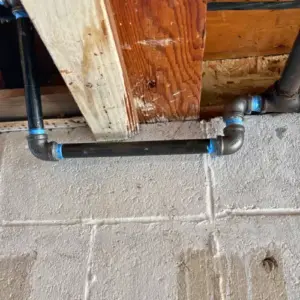
A gas-repair price should explain what is leaking, what will be replaced and how the repaired system will be checked before service resumes. If you smell gas now, leave and contact the gas utility or emergency services from a safe place.
Why does a gas repair quote include replacing more pipe?
Once the area is safe, the repair should follow the location and condition of the leak. Ask why replacing one valve or joint will not be enough and how the completed repair will be tested. If the quote also includes appliance or vent work, have the findings and charges separated.
Ask before you sign
What was found to be leaking, and why does the repair need to extend beyond that part?
A damaged section or unusable shutoff may require work beyond the first leak found. But a proposal for much more pipe should identify what is wrong with that pipe. Once the immediate danger is handled, get the failed part and the proposed replacement limits written down.
Does the repair price include getting the gas back on?
Find out who performs the required testing and who coordinates restoration with the gas supplier. A quote that ends when the new fitting is installed may leave another visit or inspection to arrange. Keep the gas off until the responsible professionals say it can be restored.
Is the leak location confirmed before repair begins?
REPAIR
When repair is worth pricing
Repair a confirmed isolated section when the surrounding system is sound and the repaired system can be fully tested.
REPLACEMENT
When replacement makes sense
Replace or redesign a wider section for multiple leaks, severe corrosion, failed transitions, inadequate sizing or concealed damage that makes spot work unreliable.
A QUOTE IN FRONT OF YOU?
What are you being told?
Pick your question. Read the short answer. Copy what to say to the plumber.
Start with the lowest-priced option that fixes the problem properly. Then ask what the next level adds. A fancy name does not tell you whether you are buying better equipment, more work or a longer warranty.
Ask to see
All package prices on one page.
The repair included in each.
Extra parts, work and warranty coverage.
YOU CAN SAY
Show me all the prices. Which option fixes my problem properly, and what does the extra money buy?
Read the detail
A package name tells you little about the work. Get the cash total and scope for every option, then identify which one corrects the diagnosed fault. Compare the extra equipment, warranty and service promises separately.
Why we ask this
ServiceTitan’s public playbook describes commissioned technicians at a seven-franchise Roto-Rooter group and training that withholds prices during the explanation. It also describes the intended benefits of clearer options. This is a specific example, not a policy established for every plumber or franchise.
THE PRICEIt took 30 minutes. Why does it cost that much?+
Check whether you agreed to a price for the whole repair or to pay by the hour. A repair price may cover travel, parts and business costs too. A quick job does not mean that money is the plumber’s hourly pay. For hourly work, check the time charged.
Ask to see
The price you agreed to.
What the repair includes.
The hours and hourly rate, if that is how you are paying.
YOU CAN SAY
Am I paying for the whole repair or by the hour? What is included, and what could cost extra?
Read the detail
First check what you agreed to buy. A fixed task price is not a timesheet: the company may build it from estimated labor, materials, overhead and profit. Finishing quickly does not tell you what the technician earns or make the bill automatically wrong. If the agreement was hourly, the rate, billing increments and time charged are the relevant comparison.
Questions are editorial examples, not quotations attributed to a particular company. Sources checked September 12, 2026. Each answer links to its supporting sources. A documented sales method does not establish what happened on your visit.
FROM MTNMANPLUMBING.COM
Recent Mountain Man work.
Published job stories matched to this guide’s plumbing services.
If gas odor or an unsafe condition is present, leave the area and contact the gas utility or emergency service as appropriate before arranging plumbing work.
Identify whether the leak is at an appliance, connector, valve, branch, concealed line or utility-owned section.
Use an appropriate test to locate and isolate the affected section, recording what was tested and what remains in service.
Retest the complete system and state the steps required before gas is restored.
The parts of this job—and why they matter
Leak confirmation
The repair starts with a documented test and a narrowed location, not a guess based only on odor.
Pipe and access
Material, diameter, concealed routing, isolation points, and the damaged length determine how the line can be repaired.
System pressure test
The affected system must be tested after work. The quote should state the test scope and who coordinates any required inspection.
Return to service
Utility coordination, appliance relighting, startup, and responsibility for inaccessible or failed appliances need a written boundary.
Quote shortcuts worth questioning
A leak location is guessed from odor or staining without a test.
A contractor promises to restore gas without a documented retest.
Utility-owned piping and customer-owned piping are not distinguished.
Emergency dispatch is presented as a permanent repair without scope or warranty.
Repair begins before the leak is located
Opening finishes or replacing random fittings is not a substitute for a defined diagnostic plan.
No full-system retest
The repaired section is only one part of the gas system; the quote should state how integrity is verified afterward.
Appliance startup assumed
Relighting and verifying appliances may be included, limited, or assigned to another party. Ask before approval.
Gas-line work treated like ordinary water piping
Licensing, testing, materials, protection, and inspection requirements make this safety-critical work.
More scope details and possible extra work
Confirm these inclusions
Diagnostic or pressure-test scope
Defined repair location and material
Required valve, fittings, supports, and protection
Post-repair system test
Permit or inspection coordination when required
Clear plan for restoring gas service and appliances
Conditions that add work
Several leaks or broad corrosion
Concealed pipe behind finished surfaces
Failed appliance valves or connectors
Meter-side or utility-owned conditions
An undersized system discovered during repair
THE DETAILS PEOPLE ASK ABOUT
Gas line repair questions
The shutoff is stuck. Can it wait until the appliance is replaced?
The installer needs a safe way to isolate the gas before disconnecting the appliance. A stuck shutoff is part of that problem, not something to work around with a longer connector or extra force. Have the valve work and required testing included in the plan. If gas is suspected to be leaking now, leave and call the utility or emergency services from a safe place.
They repaired the gas valve but it may still be leaking. What should I do?
Treat a suspected gas leak as a safety issue first: leave and call from a safe place. Do not try sealant or tighten the valve yourself. Once the immediate hazard is handled, ask the installer for the repair and test records and how the earlier warranty applies.
Separate diagnosis and safe isolation from the confirmed repair, access, materials, pressure test, inspection and restoration. Multiple leaks or concealed piping can change the scope.