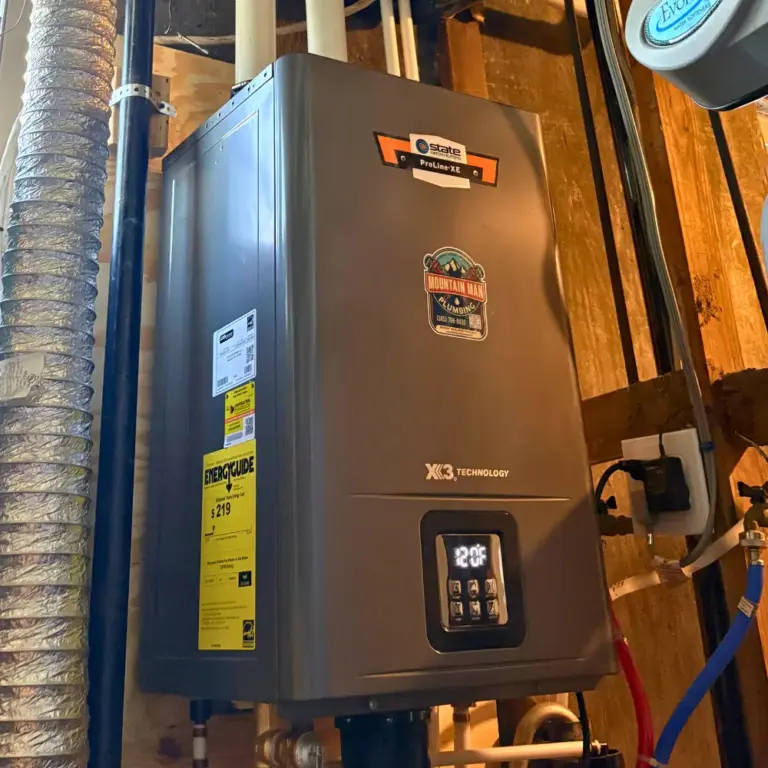
The heater is cheaper online, but the installation quotes are much higher. Before deciding whether the difference is reasonable, find out what has to change in your house to run it.
Why is the installed price so much more than the heater?
A tank-to-tankless conversion can leave the installer running a new gas pipe and finding a new route for the vent. If that means working through a cramped attic or opening a finished wall, you're buying a fair amount of work besides the heater.
Possibly, but it has to be an approved vent for that exact heater. In a house with an inaccessible attic or an expensive roof to disturb, the vent route can be the reason two otherwise similar installations cost very different amounts.
It might, but somebody needs to size the gas run for the smaller model before promising that saving. The pipe has to supply the heater at full fire along with the other appliances on the run.
A condensing heater needs a suitable drain for the water it produces during operation. With no drain nearby, the installation may need a pump. The model's instructions and local requirements also determine whether treatment of that condensate is needed.
Work through the hot water you use before paying for the upgrade.
01Can it run the showers we use at the same time?+
The winter water temperature is the catch. Heating colder water takes more energy per gallon, which cuts the hot-water flow the unit can deliver. The brochure's biggest flow number may be for much warmer water than your house gets in winter.
For two showers running together, use their combined flow and the heater's output at your winter inlet temperature. The model's flow chart is the useful page here.
Not necessarily. Below its minimum activation flow, the burner won't start. If you tend to leave the hot tap barely open, that's a specification you'll actually notice.
That depends on what you pay for propane and electricity. Removing an electric heater will reduce the electric bill, but you'll be buying propane for that hot water instead. There isn't a useful savings figure without counting both.
Even if propane works out cheaper to run, the extra installation and servicing costs affect how long it takes to recover the cost of converting.
04Who will work on this brand after it is installed?+
I'd want a name and a phone number for local service before ordering. Being able to buy a heater online doesn't mean the plumbers nearby work on that model.
What will the tankless conversion give me for the extra cost?
REPAIR
When repair is worth pricing
An existing tankless heater has a serviceable fault. Get the cause of the shutdown checked before treating it as a reason to buy another unit.
REPLACEMENT
When replacement makes sense
For a tankless upgrade, price the complete conversion alongside a tank option that supplies the hot water you need. Include the work on the house, not just the appliance.
A QUOTE IN FRONT OF YOU?
What are you being told?
Pick your question. Read the short answer. Copy what to say to the plumber.
THE WORKThey say all the extras are required. How do I check?+
Ask them to mark each required item on the quote and show the rule or equipment instruction behind it. Rules can depend on your address and the heater being installed. Ask which items you can choose to leave out.
Ask to see
Each extra and its price.
The rule or installation instruction they are using.
Who handles any required permit.
YOU CAN SAY
Which items are required at my house? Show me the rule for each one, and mark the optional extras.
Read the detail
Have each requirement named in the quote. For example, Greater Salt Lake MSD lists water-heater replacement among work requiring a permit in its jurisdiction. That does not explain every accessory on a proposal. The equipment instructions, existing installation and local building department determine what needs correcting.
THE WORKWill a tankless heater give us unlimited hot water?+
It can keep heating water, but it can only heat so much at once. Two showers and a running washer may need more than one unit can supply. Ask what this model can handle together when the incoming water is cold.
Ask to see
The exact heater model.
Which showers and appliances it can serve at once.
The output when incoming water is cold.
YOU CAN SAY
Can this model keep up with our showers and other hot-water use at the same time, even in winter?
Read the detail
Continuous hot water still has a flow limit. Rheem’s sizing guidance considers simultaneous use and incoming water temperature. The useful number is this model’s output at the temperature rise your home needs—not its largest advertised GPM figure.
THE WORKA 15-year warranty means I pay nothing for repairs, right?+
Check the details. A long warranty may cover one part, while labor coverage ends much sooner. You might still pay someone to remove the old part and install the new one. Ask what you would owe if it failed.
Ask to see
The warranty for this exact model.
How long parts and labor are covered.
Costs and types of damage the warranty leaves out.
YOU CAN SAY
If it breaks, what would I still pay? Show me how long both parts and labor are covered.
Read the detail
Covered for what? One Rheem residential tankless warranty gives qualifying installations 15 years on the heat exchanger, five on parts and one on certain labor. Its exclusions include permits, removal and disposal, code updates and scale-related failures. Those are that certificate’s terms—not a promise for every tankless unit.
Start with the lowest-priced option that fixes the problem properly. Then ask what the next level adds. A fancy name does not tell you whether you are buying better equipment, more work or a longer warranty.
Ask to see
All package prices on one page.
The repair included in each.
Extra parts, work and warranty coverage.
YOU CAN SAY
Show me all the prices. Which option fixes my problem properly, and what does the extra money buy?
Read the detail
A package name tells you little about the work. Get the cash total and scope for every option, then identify which one corrects the diagnosed fault. Compare the extra equipment, warranty and service promises separately.
Why we ask this
ServiceTitan’s public playbook describes commissioned technicians at a seven-franchise Roto-Rooter group and training that withholds prices during the explanation. It also describes the intended benefits of clearer options. This is a specific example, not a policy established for every plumber or franchise.
THE PRICEIt took 30 minutes. Why does it cost that much?+
Check whether you agreed to a price for the whole repair or to pay by the hour. A repair price may cover travel, parts and business costs too. A quick job does not mean that money is the plumber’s hourly pay. For hourly work, check the time charged.
Ask to see
The price you agreed to.
What the repair includes.
The hours and hourly rate, if that is how you are paying.
YOU CAN SAY
Am I paying for the whole repair or by the hour? What is included, and what could cost extra?
Read the detail
First check what you agreed to buy. A fixed task price is not a timesheet: the company may build it from estimated labor, materials, overhead and profit. Finishing quickly does not tell you what the technician earns or make the bill automatically wrong. If the agreement was hourly, the rate, billing increments and time charged are the relevant comparison.
Ask that before looking at upgrades. The basic option should have a clear purpose and include what is required for that repair or installation. A required part does not become optional because it is listed in a more expensive package.
Ask to see
What the basic option fixes.
The required parts and work.
What the more expensive options add.
YOU CAN SAY
Will the basic option fix this properly and include everything required? What do I get by spending more?
Read the detail
The lowest package should have a clear job to do. Ask what it repairs and whether it includes the installation work required for your equipment and home. A broader package can buy better equipment or longer coverage. Work required to make the chosen installation comply is not optional just because it appears under a premium label.
Questions are editorial examples, not quotations attributed to a particular company. Sources checked September 12, 2026. Each answer links to its supporting sources. A documented sales method does not establish what happened on your visit.
FROM MTNMANPLUMBING.COM
Recent Mountain Man work.
Published job stories matched to this guide’s plumbing services.
List the showers and other fixtures you expect to use together.
Have the installer check the model output against the incoming water temperature.
Walk through the proposed gas, vent and condensate routes before accepting a conversion price.
Get the maintenance requirements and local service arrangements for the chosen model.
Quote shortcuts worth questioning
The output promise uses only the largest flow number in the advertisement.
“Complete installation” never identifies the gas or vent changes.
Fuel savings are claimed without counting the new fuel bill.
Nobody has established who services the model locally.
THE DETAILS PEOPLE ASK ABOUT
Tankless water heaters questions
Will I keep buying filters for it?
The little screen built into the heater is often cleaned and reused. A separate scale-treatment cartridge can mean buying replacements, though. The cartridge's name and replacement cost should be available before you agree to have it installed.
Our softener quit before the tankless started acting up. Will flushing fix it?
A failed softener makes scale worth checking. I'd question a flush being offered without a diagnosis of the shutdown, though: a gas-supply or ignition fault needs a different repair.
Do I need two heaters so I still have hot water when one fails?
For backup, the proposed setup has to work with one unit out of service. How much hot water would it still deliver? That's the capacity you're buying as backup, so it belongs in the proposal for the extra heater and its connections.